Art Journal

Nature Ramblings ~ Past Times Time Travel ~ Romancing Daily Life

Thursday, October 10, 2013

Wednesday, October 9, 2013

Antique Threads - Up to Dating Ruffles and Teacups (Historic Inspiration)


If you listened to my July podcast from the fashion gallery of the Victoria and Albert (V&A) in London, you'll recall that I was in sewist heaven when it came to studying fashions in the V&A's collection.

I haven't even finished blogging about some of my ideas from that trip yet - thoughts on creating new looks based on gorgeous antique and retro garments I talked about and photographed in the V&A - before a new book purchase*  get me heading out to search the free on-web collection at the V&A museum, to look up more details from several historic beauties mentioned in this delicious book.


What's the appeal? Not only are were the
edges of these silk strips left raw, the gathered band
was also twisted in a sinuous pattern.
As a result, I have fallen for a dress. 

It's one of those sewing danger things, right? Bad enough when the inspiration garment is something I might wear only once to a wedding or a performance at the opera, but I had to get knocked over by an embroidered silk doozy from the late eighteenth century. 

We're talking here about twenty or thirty yards of silk. We're talking about major ruffles and teacups. We are talking about something that would not even fit through the door of the mini van!

It's the pinked and scalloped strips of silk on this gown** from the late eighteen century that have me itching to come up with a modern way to use this style of embellishment. But I haven't been able to see past the style of this lovely, but totally impractical for modern times (!) sack-back gown. I couldn't see it in a vest, jacket or skirt. OK, I could but the look would have been waaayyyy too fussy. 

.
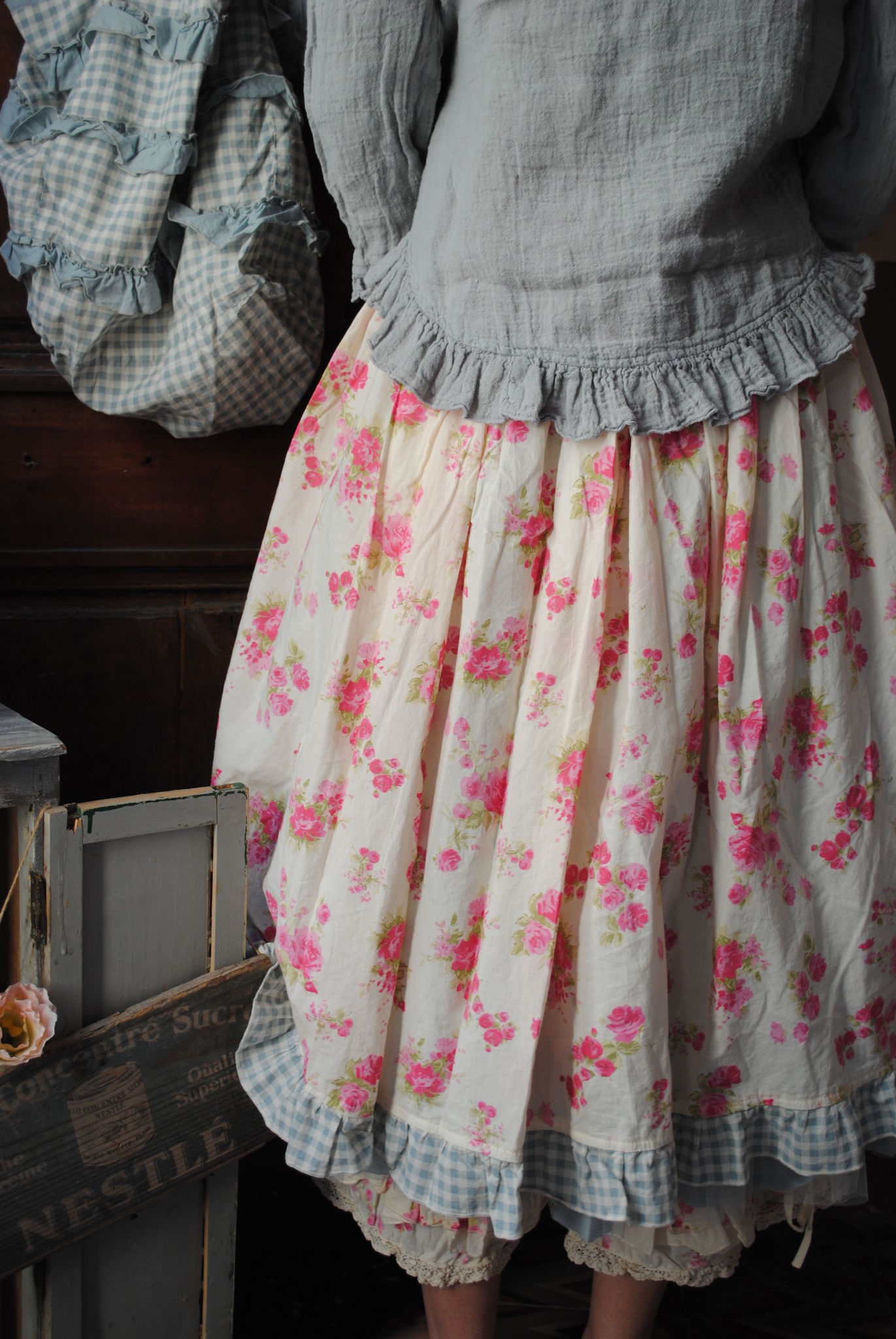
I had forgotten, however, about this outfit*** I pinned on my Pinterest Historic and Retro Sewing Board. Me oh my, it gives me ideas for deploying that really cool ruffle. 

Can't you just see that snakey, raw edged, twisted, ruffle in a very light weight denim? I can. It's slithering along the edge of a nicely flowing denim shirt or jacket. Perhaps it's just a touch narrower. And in combination with something like this floral skirt in a lovely, fluid voile - or maybe a homespun style check or plaid like the trim on this skirt -, it would really hit the spot.

I bet you know how it goes. Historically inspired, modern fashion is the kind of sewing daydream that keeps me....
Enchanted by Sewing!
~ ~ ~

Resources

* Seventeenth and Eighteenth-Century Fashion in Detail, by Avril Hart and Susan North 


Search the V&A Collections http://collections.vam.ac.uk

** Details on and photos of the glorious gold sack-back gown at http://collections.vam.ac.uk/item/O127134/sack-back-gown-unknown/

I have several Pinterest sewing theme boards at http://www.pinterest.com/lrshimer/ You don't have to join Pinterest to look at them.


*** I'm not sure of the original context for this garment. I saw it on someone else's board. The only link that comes up for it is 
http://p7.storage.canalblog.com/76/26/647625/85282790_o.jpg

Thursday, October 3, 2013

To Drape or Not to Drape - No Question About It - Ericson Is Inspired by Vionnet: (historical and modern draping)

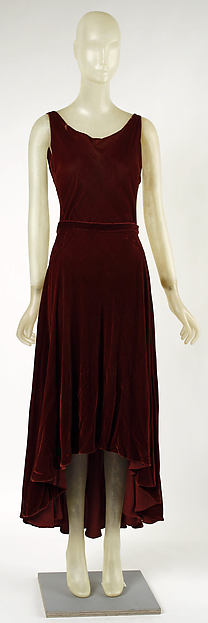
Vionnet made these gowns 
for the 
Duchess of Windsor
For Madame Vionnet, 
It was all about fabric and cut.

This past weekend I attended Artistry in Fashion (AIF)* at CaƱada College in Redwood City CA (San Francisco Bay Area). This is the school with the excellent fashion department , where I have often mentioned I take sewing and fashion design classes.

I was really looking forward to hearing the keynote speaker, Sandra Ericson **, as my draping class teacher, Judith Jackson, has studied with Ms. Ericson  and dropped a lot of little hints about this designer's experiences studying the work and designs of Madeline Vionnet. Madame Vionnet, as you probably already know, was a famed french designer and queen of the bias cut. I knew I'd enjoy the talk, but had no idea that I'd walk away absolutely inspired to learn to cut and drape some bias of my own. 
This Vionnet evening dress
makes me yearn
for a piece of silk velvet!

Having only just recently begun to learn about draping, I'm starting to get a sense of the fun involved in smoothing fabric over a dress form, capturing excess, and letting the material speak to me about where it wants to go and what it wants to do. So far in our first four working classes, we're still working with traditional straight of grain and cross grain goods. We haven't moved into bias land yet.

I can hardly wait.


Learning more about designing and sewing garments cut on the bias, is going to be another pathway that keeps this sewist, 
Enchanted by Sewing!
~ ~ ~
Talk and Draping Demo Notes 
* Very few pattern pieces used, often only one or two
* Bias expands and contracts to fit the body
* Though sewing is limited, these styles are not for beginners. Garment constructors should be "champion edge-finishers"!
*For Vionnet, it was all about fabric and cut.

Madame Vionnet was not so much a sewist as she was a "technician". She focused on cut and cloth, analyzing the construction of the cloth and ways that the fibers restricted movement  (Laurel reflects - it's about drape and sway. This reminds me of the Enchanted by Sewing podcast where I interviewed Susan S. and she described herself as a "Fashion Engineer"). 
* Sandra Ericson sometimes drapes wet. I wonder what kind of dress form she uses when she does this? I sure wouldn't drape wet on my foam core "Uniquely You" dress form! Might be OK on my duct tape dummy though...
* Ms. Ericson several times pointed out gussets she used in garments made from the patterns she designs. A couple of women behind me kept whispering, that they didn't know what a gusset is. I tore up a little piece of notebook paper and wordlessly clued them in. 

I think at one time, many home sewers knew about adding gussets for a little extra ease at key points, but in this age of commercial patterns people tend to be leery, or just unaware, of altering garments in this way.

* When you're draping, cut away what you're not going to wear
* Finished some edges with a serger and invisible thread (hem perhaps?)
* Noting S. Ericson's bolero jacket, reminiscent of Balenciaga, we learn he studied with Vionnet, tending to create garments in stiffer fabrics. Laurel thinks this pattern would make a very nice travel jacket.
* Vionnet's principle was to use nothing fake to support the shape of the garment. For example - no shoulder pads. If a sleeve needed more height, she might dart it, to make it stand up
~ ~ ~
Fabrics Used ....
on some of the sample garments displayed in Sandra Ericson's talk 
 Hold the fabric up, let it drop, and see how it hangs

*Rayon - Note rayon has a "high specific gravity" that drags a garment down (Laurel asks, Is that sometimes a good thing?)
* Rayon Twill (donut skirt)
* Silk Velvet (skirt, Komono Cool Top)
* Silk Noil - Laurel says Thai Silks (longtime business with a good reputation) , in nearby Los Altos, has very nice silk noil and they sell on the web.
* Wool Crepe (the V- dress, the Midterm dress)
* Heavy Wool Coating (we noted how differently garments made with this fabric, hung versus more drapey materials)
* Light Weight Wool Cashmere
* Upholstery Fabric (the Measure Coast - no pattern - set of instructions purchased and you make it to measure. Includes those now, very familiar, gussets!) 
* S. Ericson likes hand woven fabrics. She encourages us to see how they hang down.
* Ms. Ericson often uses Nature's Way Muslin (Rocklin?) for making toiles/muslin's when draping, but uses others as well and is checking out a new one she's found.
~ ~ ~
Resources

Fashion Engineer for Work and Play - Snakes Alive Environmental Consultant by Day, Sewist by Night 
Learning about Vionnet's focus on the technical side of working with fabrics, reminded me of this interview with Susan S.

Dress Forms? What are those? How do I get one? Can I make it myself? How much does it cost and how much time does it take?
When you drape - unless you have the luxury of a live model - you generally use a dress form. In this episode of the Enchanted by Sewing Podcast, I describe my experiences creating two different kinds of dress forms. I also provide links to another show, where Lori,  of the Sew Forth Now Podcast, talks about the history of dress forms, as well as her  pre-made, adjustable dress form.
http://www.enchantedbysewing.blogspot.com/2013/09/ench-by-sew-12-dress-forms.html

Center for Pattern Design - Ms. Ericson's Digital Studio 
 Lots of Resources plus her own Patterns for Sale http://www.centerforpatterndesign.com

Of the models I saw in the the talk - I was most partial to the four-square dress, pyramid dress, and cocoon coat. These are not Big-4, slam-bang, mass-market, discount patterns. Inspired sewists are paying for the work of a pattern-design artist. Most patterns seem to range between $20 and $35, at this time.

One place you can see examples of  Vionnet's work, is by searching  the collection of the Met Museum
http://www.metmuseum.org/toah/works-of-art/C.I.46.4.24ab,25ab

Madeleine Vionnet book by Betty Kirke - Classic study on famed draper and technical artist. Includes 30 patterns. Warning, this book is not cheap, but would you get a ton of patterns in addition to the text, so why would it be? Sandra Ericskson mentioned it many times in her talk


Drape Drape by Hisako Soto
This affordable book looks like it might be a good approach to start playing around with draping
http://www.amazon.com/Drape-Hisako-Sato/dp/1856698416/ref=pd_sim_b_4

~ ~ ~
* P.S. Next Years Keynote Speaker at Artistry in Fashion is Patti Palmer. You better believe I'll be attending again!

** Yes, Sandra is Lois Ericson's sister

Monday, September 30, 2013

Draping Haiku (Fit)

Draping class recalls

Sewing for my barbie dolls

Find the fabrics dream

The Ultimate Working Pooch - A Postcard from Buster


A Comfort Specialist for several years, Buster helps me
to be more calm and relaxed,
 when I'm having dental work done.
I wish there were more dogs in this line of work!
I once read (and I wish I could remember where I read it) that the Aztecs trained and bred special hairless healing dogs to lay on ill people and do important medical tasks. I know exactly what those fortunate people felt like...

This is Buster. He is a Comfort Specialist at Dr. Lori Doran's Dental office in Palo Alto CA, a twenty minute bike ride from my home. I called ahead to make sure Buster was on duty before I went in for my appointment, and apparently I'm not the only patient who does this. About half of Dr. Doran's patients like to have Buster's help.

Yes, those are my toes down at the end of the dental chair and Buster was laying as close to my chest as I could get him. He adjusts to whatever people want him to do. Some people like him in the knee zone, others on the lap. I like him REALLY close. It's so soothing when I'm having a crown removal and cavity workup like I did that day. 

Of course it's not a job just any pooch can do, but we certainly need more dogs (and perhaps other mammals) like Buster out there.

Thursday, September 26, 2013

Ench By Sew-12 Creating Dress Forms (Podcast Episode)

Co-Published with the Show Notes for Enchanted By Sewing


Hey! The latest Enchanted by Sewing Podcast has been published!
Two Ways to Listen
i)You can listen to the show right on the web by clicking on the this link
** * * 
~ OR ~
ii)  Click on this link to iTunes  to download this and other Enchanted by Sewing shows to your mobile device (iPhone, Android, etc.) free from iTunes 
Did I miss any links mentioned in the show? If so, please post here and let me know, or else email me ,  EnchantedBySewing AT gmail
~~~
This month show is about my experiences creating and using two different types of dress forms - 
a) A duct tape dress form
b) A Uniquely You dress form
~ ~ ~

Please send your thoughts about this month or next month's topic – Jeans Sewing -in the Post a Comment section,  below :-)
~ ~ ~

Please Note
My Uniquely You Dress Form Instructor was Judith Jackson. I referred to her as "our teacher" in the original recording, as I was waiting to ask her permission to include her name. She said 'yes' :-)

In this month's show

1) What is a dress form?
a. A mannequin who’se shaped like you. A fitting or body double, a way to fit patterns, garments, drape and design as though you’re the tailor and the dress form is you
b. Listen to Lori's Sew Forth Now Podcast for a history of dress forms
Lori not only talked about history, she also talked about the style of dress form and I’m not repeating any of that. Please listen to her wonderful show (she said it would remain there for the near future) esp interesting to me is lori’s archeologic work, uncovering the history of dress forms.
Lori uses an adjustable dress form, I worked with two different types – duct tape and a Uniquely You dress form
c.
2) Why I wanted a dress form
a. Fit
b. Trying out patterns and muslins in 3D
c.  Create and play around with my own designs, and minor commercial pattern alterations and design changes
d.  Because Lori made them sound so appealing!
e. Maybe for photographing in my blog….

3) Body Issues and your Team
a. Body issues are a part of our culture
b. Find helpers/team who help us feel good about ourselves
c. A dress form helps us distance ourselves from body issues – it’s just data
d. A dress form helps us notice our best features – what do I want to flatter more?
e. A dress form helps us make patterns or garments we design ourselves more flattering, so we learn to play up our best features
f. A dress form allows us to experiment with a muslin/toile – Can I make a shirtwaist that flatters my figure type?
g. Choosing our Team

4) Two types of dress forms I experienced. Basically what they are,  

5) Cost

6) Materials (tools)   and Resources (web stuff) - I list some Resources below

7) Safety- Working around kids,  young or older goofy, fun loving kids - Two good reasons not to !
8) Social Comfort/Body Issues – You need a work group, at least one other person. Find someone who supports your best interests and helps you feel good about yourself
9) How I’ve used my dress forms , what other things I or others might do w/ them
 - Fitting, altering, trying out new patterns, hand sewing/deconstructed neckbands - helps me conform neckline to lay well on me
- A Wedding in your future? Formal/Special Occasion Wear I would guess that if you’re doing a formal dress for someone with beading or close fitting - and maybe they aren't available at the drop of a hat, might be worth making a duct tape (or other type )  dress form for them


10) Technicos: In-depth details about how I made these two different styles of dress forms. What I actually did to create them

~ ~ ~
Resources

Listen to the Podcast on web - no need to download to a mobile device
http://traffic.libsyn.com/enchantedbysewing/draft5_dress_formENCHANTEDbySewingFINAL.mp3

There are so many fun things about dress forms - making them, draping on them,  displaying historic, artistic and other garments on them, and enjoying them as an art form - whether full sized, half size, miniature or doll size. There are even topiary forms inspired by dress forms. Whenever I see a good dress form that fits any of these categories, I pin it on one of my virtual bulletin boards http://www.pinterest.com/lrshimer/dress-forms/

Lori recorded a Sew Forth Now podcast episode on dress forms. I tried not to duplicate anything she already talked about in this great show

Dress forms are a popular theme with sewing bloggers 

"Threads" Magazine has many articles related to dress forms

Quick and Easy Duct-Tape Dress Form


Some people think Paper Tape works better than duct tape. Haven't tried it myself, but I'd be game!
      http://www.threadsmagazine.com/item/3633/paper-tape-dress-form Paper Tape Dress Form


Kenneth King make an extra body to use for two people  in Threads issue 161
 June/July 2012


I looked in the Threads Magazine Archive to find different articles. You can find that at...
http://www.tauntonstore.com/threads-magazine-issues.html  You can buy individual Threads back issues, if you or your public library doesn't have them on the shelf.


1) "Fit for Everyone" by Kenneth D. King in issue #161. This describes how to sew removable covers to make your dress form work for multiple figures.
A. "Tip: Meet Madeline" by Sandy Moeckel in issue #153. This tip describes how Sandy inexpensively made her dress form suitable for herself as well as her daughter.
1) "Tip: Identical Body Double" by Anne K. Brenz in issue #144. This tip describes the way Anne made her dress form fit her every curve.
• "The Dress Form–A Sewer's Best Friend" by Carol Fresia in issue #123. Described below.
• "Make An Arm for Your Dress Form" by Shirley Botsford in issue #90.
• "Clone Yourself a Fitting Assistant" by David Page Coffin in issue #75. This article explains how to make a dress form from scratch.

~ ~ ~
Things I might try out for arty fun and practice with my dress form 


Making a newspaper dress on a dress form. Fun way to learn draping?


A tutu might also be a fun way to experiment with draping on a dress form too "How to make a tutu out of paper" http://www.youtube.com/watch?v=qp6nKpzd0eI

Followers