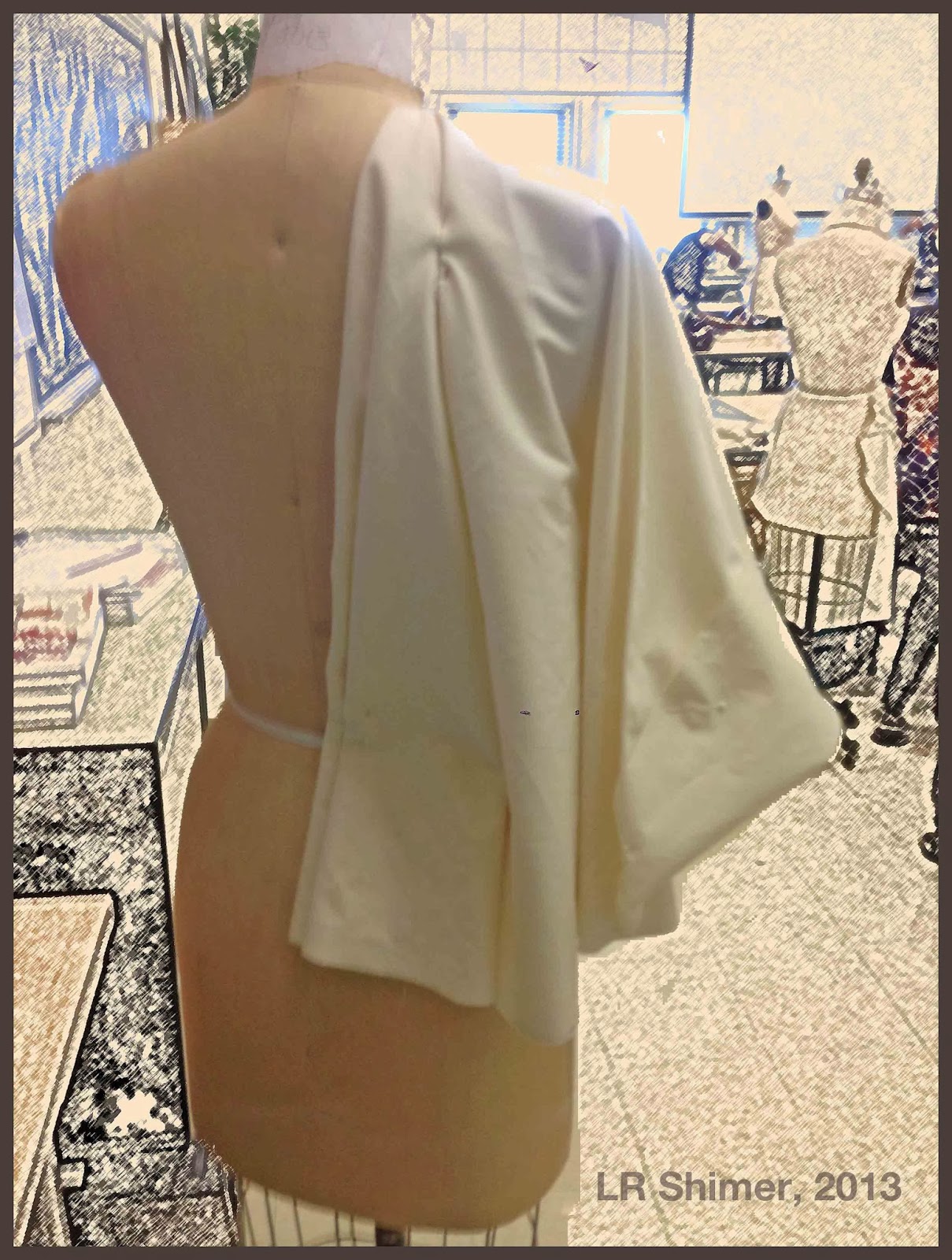
|
Vionnet made these gowns
for the
Duchess of Windsor
For Madame Vionnet, It was all about fabric and cut.
|
I was really looking forward to hearing the keynote speaker, Sandra Ericson **, as my draping class teacher, Judith Jackson, has studied with Ms. Ericson and dropped a lot of little hints about this designer's experiences studying the work and designs of Madeline Vionnet. Madame Vionnet, as you probably already know, was a famed french designer and queen of the bias cut. I knew I'd enjoy the talk, but had no idea that I'd walk away absolutely inspired to learn to cut and drape some bias of my own. 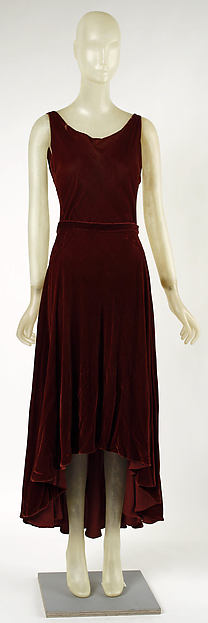 |
This Vionnet evening dress
makes me yearn
for a piece of silk velvet! |
Having only just recently begun to learn about draping, I'm starting to get a sense of the fun involved in smoothing fabric over a dress form, capturing excess, and letting the material speak to me about where it wants to go and what it wants to do. So far in our first four working classes, we're still working with traditional straight of grain and cross grain goods. We haven't moved into bias land yet.
I can hardly wait.
Learning more about designing and sewing garments cut on the bias, is going to be another pathway that keeps this sewist,
Enchanted by Sewing!
~ ~ ~
Talk and Draping Demo Notes * Very few pattern pieces used, often only one or two
* Bias expands and contracts to fit the body * Though sewing is limited, these styles are not for beginners. Garment constructors should be "champion edge-finishers"!
*For Vionnet, it was all about fabric and cut.
Madame Vionnet was not so much a sewist as she was a "technician". She focused on cut and cloth, analyzing the construction of the cloth and ways that the fibers restricted movement (Laurel reflects - it's about drape and sway. This reminds me of the Enchanted by Sewing podcast where I interviewed Susan S. and she described herself as a "Fashion Engineer"). * Sandra Ericson sometimes drapes wet. I wonder what kind of dress form she uses when she does this? I sure wouldn't drape wet on my foam core "Uniquely You" dress form! Might be OK on my duct tape dummy though... * Ms. Ericson several times pointed out gussets she used in garments made from the patterns she designs. A couple of women behind me kept whispering, that they didn't know what a gusset is. I tore up a little piece of notebook paper and wordlessly clued them in.
I think at one time, many home sewers knew about adding gussets for a little extra ease at key points, but in this age of commercial patterns people tend to be leery, or just unaware, of altering garments in this way.
* When you're draping, cut away what you're not going to wear
* Finished some edges with a serger and invisible thread (hem perhaps?)
* Noting S. Ericson's bolero jacket, reminiscent of Balenciaga, we learn he studied with Vionnet, tending to create garments in stiffer fabrics. Laurel thinks this pattern would make a very nice travel jacket.
* Vionnet's principle was to use nothing fake to support the shape of the garment. For example - no shoulder pads. If a sleeve needed more height, she might dart it, to make it stand up
~ ~ ~
Fabrics Used ....
on some of the sample garments displayed in Sandra Ericson's talk
Hold the fabric up, let it drop, and see how it hangs
*Rayon - Note rayon has a "high specific gravity" that drags a garment down (Laurel asks, Is that sometimes a good thing?)
* Rayon Twill (donut skirt)
* Silk Velvet (skirt, Komono Cool Top)
* Silk Noil - Laurel says Thai Silks (longtime business with a good reputation) , in nearby Los Altos, has very nice silk noil and they sell on the web.
* Wool Crepe (the V- dress, the Midterm dress)
* Heavy Wool Coating (we noted how differently garments made with this fabric, hung versus more drapey materials)
* Light Weight Wool Cashmere
* Upholstery Fabric (the Measure Coast - no pattern - set of instructions purchased and you make it to measure. Includes those now, very familiar, gussets!)
* S. Ericson likes hand woven fabrics. She encourages us to see how they hang down.
* Ms. Ericson often uses Nature's Way Muslin (Rocklin?) for making toiles/muslin's when draping, but uses others as well and is checking out a new one she's found.
~ ~ ~
Resources
Fashion Engineer for Work and Play - Snakes Alive Environmental Consultant by Day, Sewist by Night
Learning about Vionnet's focus on the technical side of working with fabrics, reminded me of
this interview with Susan S.
When you drape - unless you have the luxury of a live model - you generally use a dress form. In
this episode of the Enchanted by Sewing Podcast, I describe my experiences creating two different kinds of dress forms. I also provide links to another show, where Lori, of the Sew Forth Now Podcast, talks about the history of dress forms, as well as her pre-made, adjustable dress form.
http://www.enchantedbysewing.blogspot.com/2013/09/ench-by-sew-12-dress-forms.htmlCenter for Pattern Design - Ms. Ericson's Digital Studio Lots of Resources plus her own Patterns for Sale
http://www.centerforpatterndesign.comOf the models I saw in the the talk - I was most partial to the four-square dress, pyramid dress, and cocoon coat. These are not Big-4, slam-bang, mass-market, discount patterns. Inspired sewists are paying for the work of a pattern-design artist. Most patterns seem to range between $20 and $35, at this time.
One place you can see
examples of Vionnet's work, is by searching the collection of the Met Museum
http://www.metmuseum.org/toah/works-of-art/C.I.46.4.24ab,25abMadeleine Vionnet book by Betty Kirke - Classic study on famed draper and technical artist. Includes 30 patterns. Warning, this book is not cheap, but would you get a ton of patterns in addition to the text, so why would it be? Sandra Ericskson mentioned it many times in her talk
by Hisako Soto
This affordable book looks like it might be a good approach to start playing around with draping
http://www.amazon.com/Drape-Hisako-Sato/dp/1856698416/ref=pd_sim_b_4
~ ~ ~
*
P.S. Next Years Keynote Speaker at Artistry in Fashion is Patti Palmer. You better believe I'll be attending again!
** Ye
s, Sandra is Lois Ericson's sister