Art Journal

Nature Ramblings ~ Past Times Time Travel ~ Romancing Daily Life

Wednesday, July 21, 2010

Spain, Pensamientos finales

Is this Segovian Cupid waving Hasta Luego,
or simply thumbing his nose at me?


It’s time to bring my illustrated journal about my trip to Spain to a close, and return my blog to it’s regular form, as an art-journal of my daily life here in California.

The pieces I wrote about my trip are short themed entries, and are not intended as a blow-by-blow description of my trip. I've listed them below, with links for each entry. Or you can locate them by clicking on particular calendar days above the "About Me" section on this web page.

Each short piece I’ve written since I returned, includes one to four photos that I took there early in July and than brought home to alter in Photoshop. The details in these altered photos show up much better when you CLICK ON each individual PICTURE (try it with the cupids above).

It was hot and I learned to deal with that like a Spaniard. I increased my Spanish speaking confidence and reminded myself that there’s always some way to communicate what I need to – even if that means using ten words instead of the one I don’t know. The colors reminded me that I wasn't at home. When you find a good park, stick with it, and go back as often as you can. I’ll always remember visiting with a group of Madrillenos at the turtle pond at the Palacio Cristal. I gained a new appreciation of sola, when I traveled to Segovia.

Sincerely yours,

The Simple Romantic

• De Colores, On the Colors of Segovia

• PatrĂ³nes y formas, Patterns and Forms in Segovia

• Modern Edificios y Negocios of Madrid - Buildings and Businesses

• A Bit of Beauty from the Alcazar Palace(A printable luggage tag I created from an altered photo)

• The Mystery of Trenta

• Historic Edificios of Madrid

• Hace Calor, One Woman's Survival Strategy

• Enjoying the Frutas y Verduras of Madrid

• Getting Neighborly at El Palacio Cristal

• The Rain in Spain Stays Mainly in the Plain, Language Survival


Tuesday, July 20, 2010

De Colores, Segovia

Y por eso los grandes amores 
De muchos colores 
Me Gustan a mi.

(De Colores, Traditional Children's Song)


PLEASE CLICK on each of these altered pictures to see much beautiful, colorful detail


Monday, July 19, 2010

PatrĂ³nes y formas, Segovia

Roman Aqueduct in Segovia and Companion Buildings with traditional decorated walls
(altered photo)

PLEASE CLICK on this and other pictures to see the beautiful detail

It’s hard not to be awed by constructions that are this old. Especially for an American who’s accustomed to seeing only a few man-made creations even a hundred years old. Yes we do have missions in California, but they're an exception. According to Wikipedia, this Roman aqueduct still works and is the best preserved such structure on the Iberian Peninsula. It’s construction likely dates back about 1900 years.


Modern Apartment Building
(altered photo)
What really struck me in Segovia were the artful patterns on the walls. You see them everywhere, from the walls of the centuries old Alcazar palace, to clearly modern designs on buildings and above doorways. They’re cut into plaster with molds or simply pressed in with a firm instrument by hand.

Modern Detail above a Doorway
(altered photo)

View of the Tower from inside The Alcazar Palace
(altered photo)

I managed to communicate my interest in the artistic formas en las paredes to the woman who sold me my ticket to the Alcazar Palace. She replied in voluable Spanish, the gist of which I picked up. (I smiled when I understood her and repeated a lot of words and phrases to make sure I got her main points). She indicated that this is a local art form, specific to the that area. I replied that when my parents built a house in Ventura, California the one thing they did pay someone else to do was to form beautiful patterns in the plaster that adorned the house. We speculated that perhaps some of the ancestors of those artesanos Mexicanos might have come from the area around Segovia.

* As my parents had done a number of other times, they built that house with their own hands – they didn’t pay someone else to build it


The Alcazar Palace
(altered photo)
CLICK on the picture and Check out those walls!


Sunday, July 18, 2010

Modern Edificios y Negocios (Madrid)

PLEASE CLICK on these pictures to see the lively detail.


Modern buildings and city businesses in an unfamiliar country, are just as intriguing as the historical ones. They look so similar to the ones I know at home but, then again, something tells me that I'm not in Kansas any more.


Saturday, July 17, 2010

A Bit of Beauty from the Alcazar Palace, Segovia (printable tag)

Please CLICK ON THIS PICTURE to see the lovely detail.

The tag prints well on postcard stock and can be used for a gift, organizational or luggage tag.


I created this tag from a photo I took of a ceiling medallion at the gorgeous Alcazar Palace in Segovia. I wrote a bit about my day trip to Segovia in a previous blog entry, "The Rain in Spain, Stays Mainly in the Plane". The Alcazar is, of course, the palace where Queen Isabella retreated for safety's sake, shortly before she was proclaimed Queen of Castille. Modern western people tend to remember this queen more than others because she was the mother of Henry VIII's first wife, Katherine of Aragon, as well as financier of Christopher Columbus.

Isabella is one of those gals about whom I have mixed feelings. She sounds like a pretty strong woman, a good example of feminine power and strength. But she was also one of the main instigators of the Inquisition, a centuries long event of genocidal terror bent on stamping out religious tolerance among Spanish Jews, Muslims and Christens. Isabella wasn't the first ruler to think that her way was the only way, but she was a terrible crusader for her own cause. She left a legacy that continued from her time, in the late 1400's, in one form or another up until the 1800's.

Friday, July 16, 2010

The Mystery of Trenta (Madrid)


As always, PLEASE CLICK ON these pictures to see more lovely detail.

Window of Horno La Santiguesa

I looked all over the web for a recipe for a wonderful little braided sweet bread I found at this bakery on Calle Meyor, not too far from Palacio Real.* It's called 'trenta' (not treInta - the baker in the panaderia edited my hand-written note).
The only recipe I found was one for some Slovakian bread that is totally different. I know it was kind of like brioche but not as rich. It also had a little cinnamon twisted in.

the mysterious trenta

My search on recipes for "spanish bread" did turn up a wonderful recipe for camote, a sweet potato bread (recipe below). It was NOTHING LIKE THE TRENTA, but it is delicious. I found it in a great blog called Kusina ni Manang, which is a lot of fun to read. The author describes her entries as, A Filipina's unabashed chronicle of her adaptations in the American kitchen. The bread is extremely good. I made the dough - only, as I always do, in a two-pound loaf bread machine, then shaped it in pans, let it rise once more in a 200 degree oven, and baked it in a regular oven at 350 degrees. With the alterations I made to the recipe (removing the butter and increasing the sweet potato, changing milk and water to buttermilk) it baked very fast. Two loaves done around 25 - 30 minutes after the oven rise.


Another friendly-looking
panaderia window


The author of Kusina ni Manang says about this recipe, "Camote is very cheap in the Philippines compared to flour, and the soft yellowish rolls they create will probably boost up sales and profit.

"

I don't know about sales and profit but the soft yellow bread is sure good.

The following is my re-interpretation of this recipe.

I run the machine on the dough cycle and bake it in the oven, so it bakes and looks like real bread.

* Spray or oil the bread machine pan first. It's a sticky dough.

Put in the wet stuff.

3/4 cup 2% buttermilk (original was 
1 / 2 cup milk and 1 / 4 cup water
)

1 / 2 cup boiled and mashed sweet potato
 (this was about one regular sized sweet-potato, skinned and mashed with a potato masher)

1 large egg


Put in the dry stuff.

1-1/2 teaspoons salt


5 shakes from the cinnamon shaker (my addition)

3 cups bread flour (I ran out of bread flour and so did the grocery store. Regular unbleached works fine in this.)

Make a dent (well) in the top of the flour.

Fill with following yeast and sugar mixture

(sugar helps the yeast work, this position keeps yeast dry until wet ingredients are heated up to the right yeast-working temperature)

1/4 cup white sugar


1/6 cup brown sugar (not in original recipe)

2 tsp Fleischmann's bread machine yeast


* Let the machine run on the dough cycle

* Once the dough cycle has run it's course (1:30 on my machine), then shape into 2 greased loaf pans (or one loaf pan for a really, really high loaf)

* Put into a 200 degree oven and let them rise once more for 20 minutes

* Switch oven over to 350 degrees and bake for 25 - 30 minutes. A really, really big loaf takes about 35 minutes. I stick a knife right down in the middle to make sure they are done. Yeah, it leaves a hole but you know your bread is done. If you like to tap instead, go for it.

Very good with some healthy-type margarine and honey

* Yes, I carefully wrote down the address and location in comparison to other well-known buildings in the travel notebook I lost on the airplane home.


Thursday, July 15, 2010

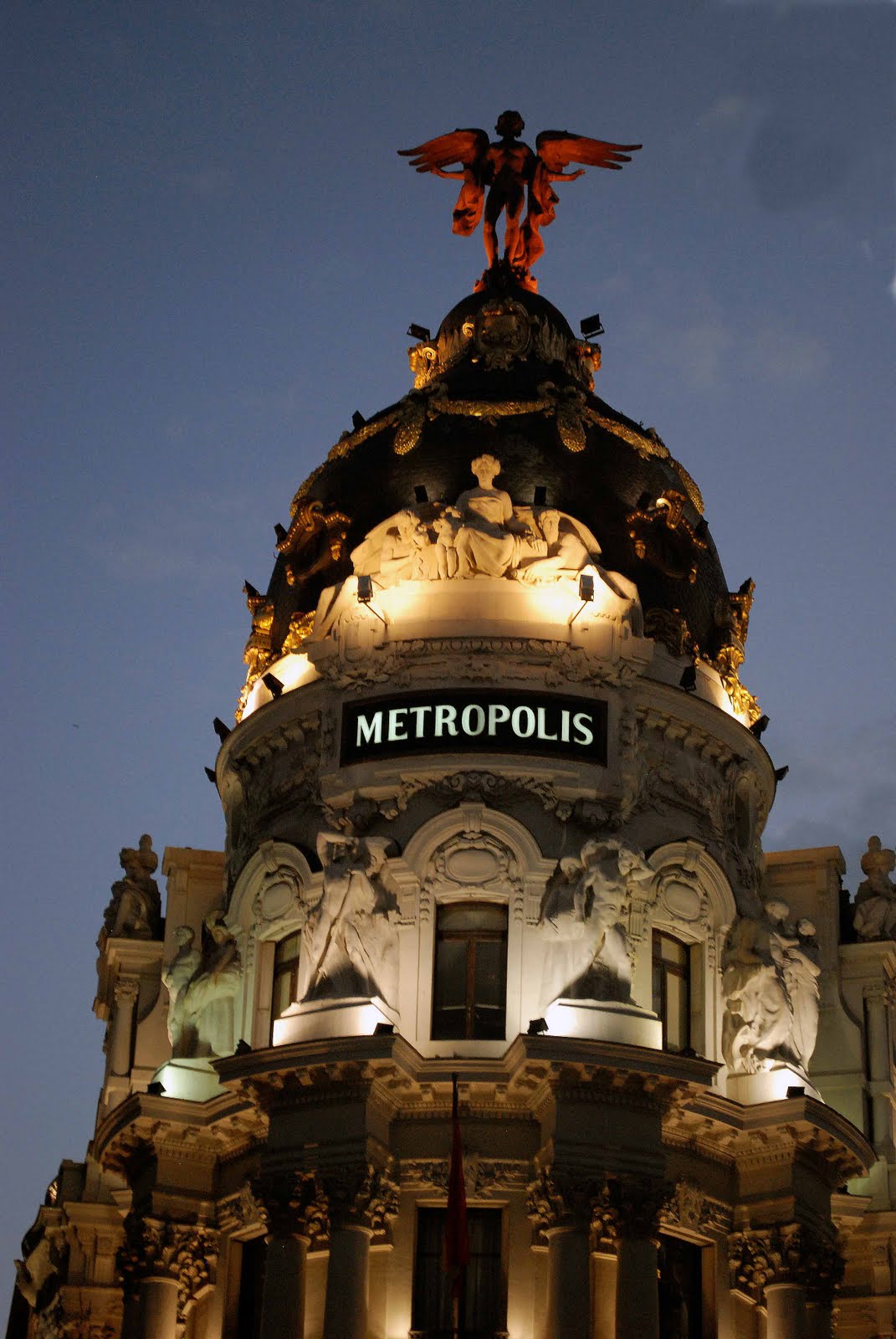
Impressions of Madrid, Historic Edificios

Please CLICK ON Each Picture To See The Lovely Detail

Gran Via


As an American, I'm not used to seeing really old, ornate buildings right where I live. I wrote in yesterday's entry about scheduling my trip around early morning and late evening walks.


Followers