Art Journal

Nature Ramblings ~ Past Times Time Travel ~ Romancing Daily Life
Showing posts with label design. Show all posts

Thursday, September 10, 2015

Ench By Sew-36: Fiona, the Irish Laurel Dress


Dress creation brings out the romantic in me. When I looked ahead to my summer sewing, I thought if I could sew only one garment for the season, it would be a dress. Fiona, the Irish Laurel dress, satisfied my yearning to design and sew the perfect summer frock.

Hey let’s listen to the show! To do that you can either download the ‘cast from iTunes - Click on this link to iTunes  , 
*OR* listen directly on the web, by clicking on this link
* * *

This dress was a very satisfying project for my arty romantic style

In between sewing summer essentials - shorts and tees - I worked off and on to determine what design lines spoke to me about summer, mock up a miniature sloper pattern to test my ideas, draft a pattern from my sloper, and then finally to sew up Fiona, while summer was still on!


* Pensamientos Primeros - Thinking through my idea for this summer dress
     - Part 1 - Planning Fiona
        - Part 2 - Farewell to Summer Romancing Fiona, the Irish Laurel Dress  
*Technicos - Pattern Drafting and Kissing Zipper using a Prick Stitch

*Pensamientos Finales - Fiona's Design Lines have roots in my own history

Finians Rainbow was a modern American fairy tale. It expressed late 1960's dreams for racial harmony and folks coming together. Fred Astaire (Finian McLonigan) and Petula Clark(his daughter Sharon) added in the romance of America seen, and idealized, fresh from Irish eyes. The story of Finian's determination to plant himself a crop of Irish gold, intertwined with romance of countryside and a new happpily-ever-after love for Sharon draws me in as well today as it did when I was a kid who'd only recently arrived in a new place myself. Any wonder that the movie's costumes inspire my pattern work and sewing today?


Visit Me Encanta Coster/Enchanted by Sewing - my regular sewing blog for other summer sewing I enjoyed along the way... in between time spent bringing Fiona to life

Monday, August 10, 2015

Ench By Sew-36: Fiona, the Irish Laurel Dress


Dress creation brings out the romantic in me. When I looked ahead to my summer sewing, I thought if I could sew only one garment for the season, it would be a dress. Fiona, the Irish Laurel dress, satisfied my yearning to design and sew the perfect summer frock.

Hey let’s listen to the show! To do that you can either download the ‘cast from iTunes - Click on this link to iTunes  , 
*OR* listen directly on the web, by clicking on this link
* * *

This dress was a very satisfying project for my arty romantic style

In between sewing summer essentials - shorts and tees - I worked off and on to determine what design lines spoke to me about summer, mock up a miniature sloper pattern to test my ideas, draft a pattern from my sloper, and then finally to sew up Fiona, while summer was still on!


* Pensamientos Primeros - Thinking through my idea for this summer dress
     - Part 1 - Planning Fiona
        - Part 2 - Farewell to Summer Romancing Fiona, the Irish Laurel Dress  
*Technicos - Pattern Drafting and Kissing Zipper using a Prick Stitch

*Pensamientos Finales - Fiona's Design Lines have roots in my own history

Finians Rainbow was a modern American fairy tale. It expressed late 1960's dreams for racial harmony and folks coming together. Fred Astaire (Finian McLonigan) and Petula Clark(his daughter Sharon) added in the romance of America seen, and idealized, fresh from Irish eyes. The story of Finian's determination to plant himself a crop of Irish gold, intertwined with romance of countryside and a new happpily-ever-after love for Sharon draws me in as well today as it did when I was a kid who'd only recently arrived in a new place myself. Any wonder that the movie's costumes inspire my pattern work and sewing today?


Visit Me Encanta Coster/Enchanted by Sewing - my regular sewing blog for other summer sewing I enjoyed along the way... in between time spent bringing Fiona to life

Friday, December 20, 2013

Draping Lucy - Terminado! New Dress and back to Rec Sewing


Lucy is the first garment I've
created  from a pattern I
made entirely myself, on my
custom dress form.

I haven't done any regular, recreational sewing all semester (one semester = 16 weeks) because I've been focused on the class work and final projects for my two fashion classes at Cañada College. The first class was Pants Drafting, taught by Lynda Maynard (that's the woman who knows what we really want to sew, and teaches us how to do it!)  In that class, I used drafting techniques,  and many fitting followups, to produce inumerable muslin garments, tissue pattern drafts, and my first pair of jeans. Can't wait to use that pattern again and again!

My second class was Draping. This class is excellently taught by Judy Jackson. Again I went through a lot of muslin, this time learning to design my own patterns by draping them in muslin fabric on a dress form, then creating tissue patterns from those draped garments. You may have seen some of my posts this fall that showed off some of the basic garment shapes I created on a standard sized 10 dress form (I called her Babs, a name that seemed appropriate for a mannequin who came to life in the early '60's). I also began draping on my own custom dress form that I created over the summer. 

When I last talked about my custom dress form I was calling her Colette, but I've since realized that she is really a Conchita
I found working with Conchita even more challenging than working with Babs, and Babs wasn't an easy customer. Was it because Conchita represented clothing I actually plan to wear? I'm not sure yet. But if I figure it out, I'll let you know!

Starting around midterm time, I spent several weeks creating a muslin sloper (a fitted bodice and fitted straight skirt) for Conchita. For some reason I found this very challenging, though I had produced the same garments for Babs. My teacher seemed to think that there should be the same amount of challenge, if only I was careful with my measuring. I worked very hard to be exact but all I can say is that it was much harder for me and just took a lot of time, muslin, tissue and patience.

Another view of Lucy
As you can see, I moved on from my sloper to make my first garment. I had originally planned to make a traditional shoulder-yoked, dropped shoulder, shirtwaist dress with a collar and front button plackets. I was of two minds as to whether the dress would have a separate skirt joined by a waistline seam or be a one piece dress. I was planning to use a beautiful piece of deep forest green silk noil (raw silk) that I have for that dress. In my mind the dress I was planning to drape was named Ivy. I'm still planning to take up with Ivy in the not to distant future. But I got distracted by Lucy....

I'll be writing more about the process of draping Lucy in upcoming postings in this journal. One thing I know I'll be reflecting on repeatedly, is learning to read the fashion fabric's story. This lesson came from my experiences in both my pattern-creation classes this semester. In both cases I saw that constructing beautiful garments is not just about designing a piece in my mind or on a sketch pad. It really comes down to watching the behavior of the fabric I've chosen to sew with, after it's cut out and initially put together on me or my custom dress form. Creating a muslin test garment is an important part of the pattern making process, but once I start the ball rolling with muslin, I then really have to listen to the story the actual material for that garment is telling me. That's what is going to guide me to bring the garment I'm sewing to life.

Learning to listen to, and read the fabric's story really keeps me
Enchanted by Sewing
~ ~ ~ 

Resources

You can drape on a person or on a dress form. When creating for ourselves, it's easiest to use the dress form approach!

In the September Enchanted by Sewing Audio Podcast Dress Forms Episode, I described my experiences creating two different dress forms. You can listen to this talk either online on the web, or you can download the show to your mobile device (like an iPhone, Android, etc.)
http://www.enchantedbysewing.blogspot.com/2013/09/ench-by-sew-12-dress-forms.html

I'm just beginning to learn the historic and modern art of draping. It's a very artistic experience !  I've begun to develop my skill set in a class taught through the Cañada College Fashion Department. I'll be continuing my draping journey by continuing to follow the richly illustrated draping tutorials and examples in our class textbook, The Art of Fashion Draping. This excellent, and highly regarded book, by Connie Amaden-Crawford has been in use for decades. both within the industry, and by home sewists. 

Thanks Sponsors! 
When you buy products through links in this blog, you support the regular work of this blog and The Enchanted by Sewing Podcast.

Tuesday, November 19, 2013

Waistlines:Inspired by the Classics - Time Travel to the Italian Renaissance

The Combat of Love and Chastity
If I'd been an all around, well educated, know-it all Renaissance women, an uomo universale  (the modern term is a polymath), I bet I'd have been dreaming in Greek - in my Greek-inspired, just-below-the-bustline waistlines that is!

The Renaissance , or rebirth, was about fifteenth and sixteenth century Italians dreaming about being reborn - as imaginary Greeks. Men and women of this era (at least those who could afford the luxury of being well educated) prided themselves on their breadth of knowledge in the arts and sciences - music, conversation, mathematics, machines, equipment, painting, architecture, books, languages, and what else..... or yeah, the art of warfare.

I'm pretty sure that if I travelled back through time to sometime in the sixteenth century, I'd have been particularly caught up in the excitement over the creation of new technology. And it seems to me that the creation of a telescope would have provided me with much of the same pleasure as my modern times enthusiasm for software development.

But I wouldn't have been crouching over my design table all day long. After all  I would have been an uomo universale, 
a woman capable of engaging in and demonstrating many accomplishments.

Whilst singing and playing my viola or lute (always with a fine air of
Woman Playing the Viola, Solario
sprezzatura),  bandying over the significance of the positions of the constellations with a fellow courtier ("But look at Mars through my new telescope Andrea!"), and planning the next poetic verse in my current composition, I'm pretty sure  I'd also have been hard at work on another mental composition, a gown inspired, of course, by 
my supposed Grecian roots*. I might have already been wearing something that took me back to those times past,   something with a twisted shoulder element perhaps, like the one in Solario's painting of a musician.
Chaste Women in a Landscape

While I was fiddling, singing and discoursing among my fellows,  I would have been contemplating the creation of a dress with a substantial dose of color. My classical interests would go for something with simple, fluid lines. No fussy necklines or over embellishment for my gown. It would speak for itself in the way it flowed from a high waistline set just below the bust, creating long lines of naturally occurring seamless folds over the body,  in hues of russet or red. In cooler weather I might pair it with a cloak of deep forest green.

Whether it was dress design or a new ability to view the heavens, I'd have been stretching my interests just as far afield back in the sixteenth century, as I do today. 


You know, it's time travel like this that keeps me...
Enchanted by Sewing!

* * * 
Thank you for sponsoring the regular work of this sewing journal site, and the Enchanted by Sewing Podcast when you buy products linked from this page!

"Prince of Foxes", set in the Italian Renaissance, is one of my all time favorite movies. It's based on a classic Samuel Shellabarger novel of the same name.  The movie is adventurous and romantic. The costumes are historically accurate and gorgeous.


* Of course women's position in Greek society didn't tend towards the well educated. These gals tended to be more like domestic appurtenances with no equal standing alongside the boys. A well-educated, monied Renaissance women could hope for a lot more when it came to society, education and an attitude of respect from her menfolk.


~ ~ ~
Resources
Uomo Universale/The Polymath

http://en.wikipedia.org/wiki/Polymath
http://alexpetrov.com/memes/hum/renaissance-man.html

Thursday, November 7, 2013

Waistlines: Designing Without - The No-Waistline Look

This gorgeous no-waistline frock is from the
This month I'm musing on the different waistline levels I select to sew.

The no-waistline look in this Dolce & Gabbana dress, sets off the gorgeous fabric* the designer used. No sewist would want to cut through this print!

When we choose a waistline style - or lack of one - by selecting a pattern, designing a flat pattern, or designing by draping our own pattern, we are choosing where the garment, or a part of the garment, hangs from on the body for which we are sewing. 

In this case, where there is no waistline, the garment hangs from the shoulders. The folds of this garment drape from the high bust point. If the model were more curvaceous in that area, the folds could hang differently, and the way that the print is displayed might be different too. 

We drape material on human-shaped dress forms, to see how different body types affect the fall - or drape- of a particular piece of fabric. We also look at how the material's textures and prints will hang on a similarly shaped human form.

~ ~ ~
Resources
I'm just beginning to learn the historic and modern art of draping. It's a very artistic experience !  I've begun to develop my skill set in a class taught through the Cañada College Fashion Department. I'll be continuing my draping journey by continuing to follow the richly illustrated draping tutorials and examples in our class textbook, The Art of Fashion Draping. This excellent, and highly regarded book, by Connie Amaden-Crawford has been in use for decades. both within the industry, and by home sewists. 

Thanks Sponsors! 
When you buy products through links in this blog, you support the regular work of this blog and The Enchanted by Sewing Podcast.

Fabric Notes
* The print in the Dolce & Gabbana frock above is quite reminiscent of one of the Alexander McQueen fashions I talked about in the fashion gallery audio podcast tour I shared from the Victoria and Albert (V&A) Museum in London last summer. In that tour, I give catalog information, so that listeners can use links from the show notes to look up further museum cataloging information about, and find images of, garments that were mentioned during that tour. 

For links to the V&A collections database, follow the show notes link at http://enchantedbysewing.blogspot.com/2013/07/ench-by-sew-010-v-fashion-gallery-tour.html

~ ~ ~
You May Also Like 

Waistlines:  What's Natural? (Haiku)
http://meencantacoser.blogspot.com/2013/11/waistlines-whats-natural-haiku.html

Enchanted By Sewing Audio Podcast: Dress Forms http://www.enchantedbysewing.blogspot.com/2013/09/ench-by-sew-12-dress-forms.html

My Virtual Bulletin Boards on Pinterest

Draping Inspiration Images and Articles - http://www.pinterest.com/lrshimer/draping-inspiration/

Dress Forms Articles, Arty, Make Your Own, Etc - http://www.pinterest.com/lrshimer/dress-forms/

I have several other sewing related Pinterest boards - http://www.pinterest.com/lrshimer/boards/

Wednesday, October 16, 2013

Vionnet and Ericson Inspired my Circular Work (Draping)

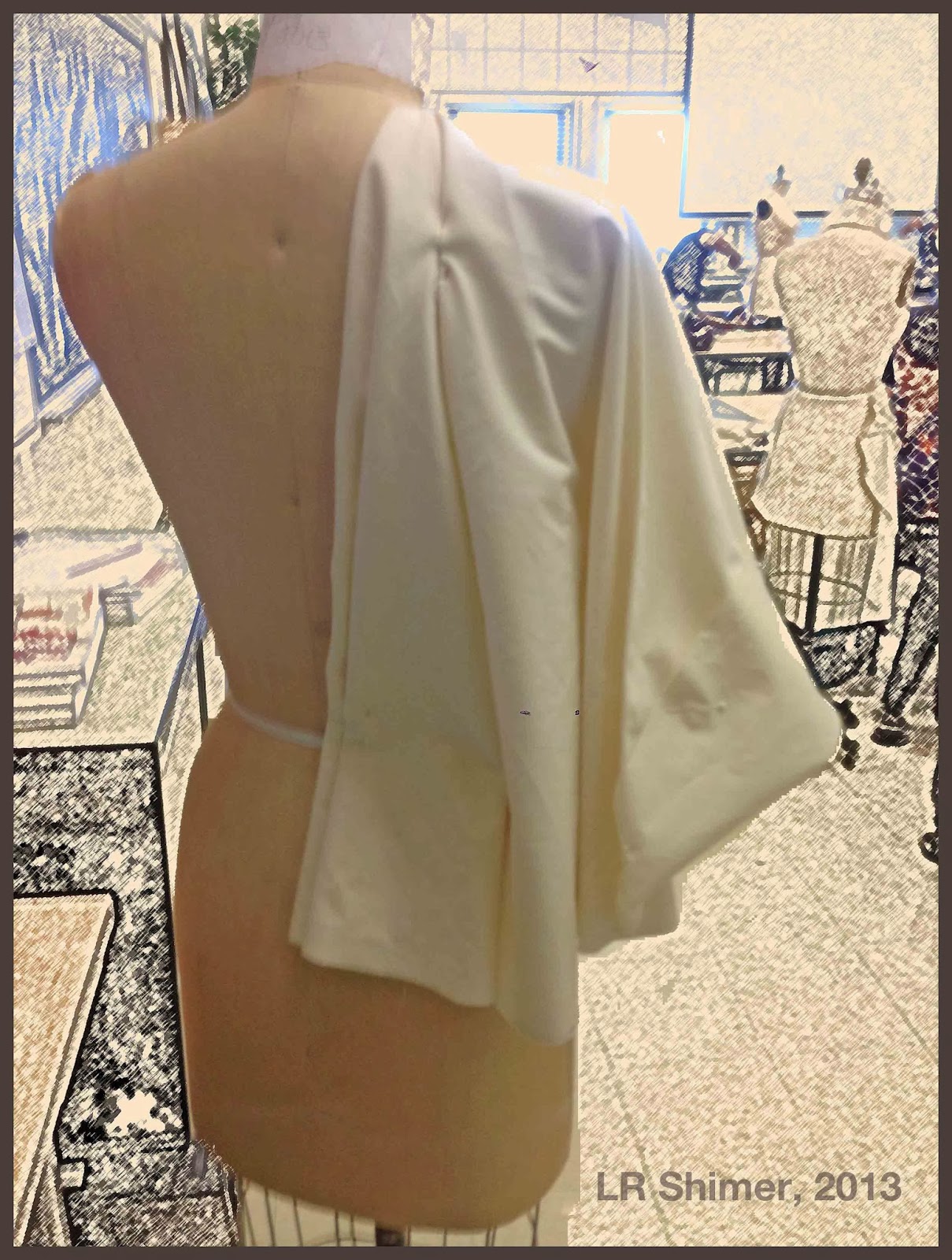
Back of imaginary jacket I created from a full circle
Sandra Ericson's recent talk on her fashions, inspired by the work of Madeline Vionnet, has me looking at dress forms with a new eye.

In a recent draping class (our midterm actually) we were asked to fold a square of fabric - I chose a 45 x 45 square, round it off into a circle and see what we could create. 

This is one of my designs. In this case I cut a line along one radian of the circle.


Here's the fantasy front
I like how it swings!
I wonder if that sleeve I created by simply pinning a line up from the edge, part way, would fit me? And would that tuck coming down from the shoulder at an angle fall well, and be comfortable on my body?

I liked the way the cuff rounded up from the base of the circle. That is something I plan to try in a real garment.

I also plan to try out the multiple layers of hem, at different levels. Some kind of sheer floaty fabric - like voile or silk organza - would  be nice for that. Wool jersey would be good too, but with our climate, I'd get very little use out of a jacket made from that.


My favorite features?
The triangle pocket, the diagonal shoulder tuck,
and the curved cuff.

The swinging lapel in the front, gave me the opportunity to create a little chest pocket at the top, another feature I'm definitely going to integrate into a real jacket!


Playing with circles in fashion lab is the kind of thing that keeps me,
Enchanted by Sewing!


~ ~ ~ 
Resources

Sandra Ericson and Madeline Vionnet - Modern fashion inspired by historical beauties

http://meencantacoser.blogspot.com/2013/10/to-drape-or-not-to-drape-no-question.html

If this were a real, complete garment - which it's not - it would be a Zero Waste Pattern. Zero Waste designs are something I'd like to create. Here's an article about them, I found on Sandy Ericson's site.
dn.shopify.com/s/files/1/0131/0182/files/Zerowaste.pdf?1471

Thursday, October 3, 2013

To Drape or Not to Drape - No Question About It - Ericson Is Inspired by Vionnet: (historical and modern draping)

Vionnet made these gowns 
for the 
Duchess of Windsor
For Madame Vionnet, 
It was all about fabric and cut.

This past weekend I attended Artistry in Fashion (AIF)* at Cañada College in Redwood City CA (San Francisco Bay Area). This is the school with the excellent fashion department , where I have often mentioned I take sewing and fashion design classes.

I was really looking forward to hearing the keynote speaker, Sandra Ericson **, as my draping class teacher, Judith Jackson, has studied with Ms. Ericson  and dropped a lot of little hints about this designer's experiences studying the work and designs of Madeline Vionnet. Madame Vionnet, as you probably already know, was a famed french designer and queen of the bias cut. I knew I'd enjoy the talk, but had no idea that I'd walk away absolutely inspired to learn to cut and drape some bias of my own. 
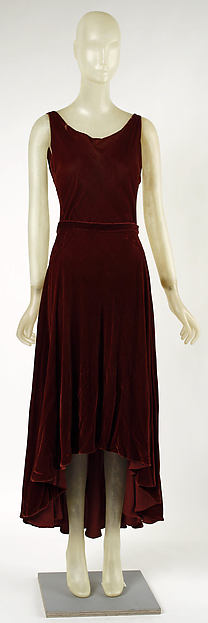
This Vionnet evening dress
makes me yearn
for a piece of silk velvet!

Having only just recently begun to learn about draping, I'm starting to get a sense of the fun involved in smoothing fabric over a dress form, capturing excess, and letting the material speak to me about where it wants to go and what it wants to do. So far in our first four working classes, we're still working with traditional straight of grain and cross grain goods. We haven't moved into bias land yet.

I can hardly wait.


Learning more about designing and sewing garments cut on the bias, is going to be another pathway that keeps this sewist, 
Enchanted by Sewing!
~ ~ ~
Talk and Draping Demo Notes 
* Very few pattern pieces used, often only one or two
* Bias expands and contracts to fit the body
* Though sewing is limited, these styles are not for beginners. Garment constructors should be "champion edge-finishers"!
*For Vionnet, it was all about fabric and cut.

Madame Vionnet was not so much a sewist as she was a "technician". She focused on cut and cloth, analyzing the construction of the cloth and ways that the fibers restricted movement  (Laurel reflects - it's about drape and sway. This reminds me of the Enchanted by Sewing podcast where I interviewed Susan S. and she described herself as a "Fashion Engineer"). 
* Sandra Ericson sometimes drapes wet. I wonder what kind of dress form she uses when she does this? I sure wouldn't drape wet on my foam core "Uniquely You" dress form! Might be OK on my duct tape dummy though...
* Ms. Ericson several times pointed out gussets she used in garments made from the patterns she designs. A couple of women behind me kept whispering, that they didn't know what a gusset is. I tore up a little piece of notebook paper and wordlessly clued them in. 

I think at one time, many home sewers knew about adding gussets for a little extra ease at key points, but in this age of commercial patterns people tend to be leery, or just unaware, of altering garments in this way.

* When you're draping, cut away what you're not going to wear
* Finished some edges with a serger and invisible thread (hem perhaps?)
* Noting S. Ericson's bolero jacket, reminiscent of Balenciaga, we learn he studied with Vionnet, tending to create garments in stiffer fabrics. Laurel thinks this pattern would make a very nice travel jacket.
* Vionnet's principle was to use nothing fake to support the shape of the garment. For example - no shoulder pads. If a sleeve needed more height, she might dart it, to make it stand up
~ ~ ~
Fabrics Used ....
on some of the sample garments displayed in Sandra Ericson's talk 
 Hold the fabric up, let it drop, and see how it hangs

*Rayon - Note rayon has a "high specific gravity" that drags a garment down (Laurel asks, Is that sometimes a good thing?)
* Rayon Twill (donut skirt)
* Silk Velvet (skirt, Komono Cool Top)
* Silk Noil - Laurel says Thai Silks (longtime business with a good reputation, in nearby Los Altos, has very nice silk noil and they sell on the web.
* Wool Crepe (the V- dress, the Midterm dress)
* Heavy Wool Coating (we noted how differently garments made with this fabric, hung versus more drapey materials)
* Light Weight Wool Cashmere
* Upholstery Fabric (the Measure Coast - no pattern - set of instructions purchased and you make it to measure. Includes those now, very familiar, gussets!
* S. Ericson likes hand woven fabrics. She encourages us to see how they hang down.
* Ms. Ericson often uses Nature's Way Muslin (Rocklin?) for making toiles/muslin's when draping, but uses others as well and is checking out a new one she's found.
~ ~ ~
Resources

Fashion Engineer for Work and Play - Snakes Alive Environmental Consultant by Day, Sewist by Night 
Learning about Vionnet's focus on the technical side of working with fabrics, reminded me of this interview with Susan S.

Dress Forms? What are those? How do I get one? Can I make it myself? How much does it cost and how much time does it take?
When you drape - unless you have the luxury of a live model - you generally use a dress form. In this episode of the Enchanted by Sewing Podcast, I describe my experiences creating two different kinds of dress forms. I also provide links to another show, where Lori,  of the Sew Forth Now Podcast, talks about the history of dress forms, as well as her  pre-made, adjustable dress form.
http://www.enchantedbysewing.blogspot.com/2013/09/ench-by-sew-12-dress-forms.html

Center for Pattern Design - Ms. Ericson's Digital Studio 
 Lots of Resources plus her own Patterns for Sale http://www.centerforpatterndesign.com

Of the models I saw in the the talk - I was most partial to the four-square dress, pyramid dress, and cocoon coat. These are not Big-4, slam-bang, mass-market, discount patterns. Inspired sewists are paying for the work of a pattern-design artist. Most patterns seem to range between $20 and $35, at this time.

One place you can see examples of  Vionnet's work, is by searching  the collection of the Met Museum
http://www.metmuseum.org/toah/works-of-art/C.I.46.4.24ab,25ab

Madeleine Vionnet book by Betty Kirke - Classic study on famed draper and technical artist. Includes 30 patterns. Warning, this book is not cheap, but would you get a ton of patterns in addition to the text, so why would it be? Sandra Ericskson mentioned it many times in her talk


Drape Drape by Hisako Soto
This affordable book looks like it might be a good approach to start playing around with draping
http://www.amazon.com/Drape-Hisako-Sato/dp/1856698416/ref=pd_sim_b_4

~ ~ ~
P.S. Next Years Keynote Speaker at Artistry in Fashion is Patti Palmer. You better believe I'll be attending again!

** Yes, Sandra is Lois Ericson's sister

Tuesday, August 6, 2013

Antique Threads: Miss Firbank's Pink Linen Cuff (Victoria and Albert Fashion Gallery)

One hundred of
Miss Heather Firbank's
garments can by found by
searching the V&A collection
In the Enchanted by Sewing Podcast for July, I took my listeners on an audio tour of London's Victoria and Albert Fashion Gallery. There I described numerous historic garments, as I encountered them. (You can listen to this podcast on line, or download it to your iPhone, Android or other mobile device http://www.enchantedbysewing.blogspot.com) You'll recall that several of the fashions I mentioned in the show, were from the wardrobe of Miss Heather Firbank (daughter of M.P. Sir Thomas Firbank and sister of the novelist Ronald Firbank). She wore them in the early part of the twentieth century (Edwardian  Era 1910-1920).


Well of course that bodice lace is
gorgeous. And we always get a kick from
the s-shaped bodice that made fashionable
gals look like pouter pigeons.
One of Miss Firbank's garments was a beautiful pink linen day dress. It's got a very Gibson Girl look, and reminds me of several of the photos from Agatha Christie's autobiography. You can read more about this dress yourself, by following this link to the V&A collection . That link also brings up other views of the dress and more about the garment. Don't get me started on the pouter pigeon/S-Shaped look and the kind of corset a woman had to wear to create that shape under her clothes. Let's just say that her inner organs were possibly affected and leave it at that.

What most struck me, other than fact that I am particularly
Love the way the round shape of the
self-fabric covered button
draws attention to the squared off tabs
and rounded half circle rising up to meet it.
The lace is pretty,
but don't you think it distracts from
the cuff?
partial to pastel shades of linen, was the cuff.   I'm glad I snapped some detail showing the cuff, because whoever took this part of the collection photograph for the V&A, went mainly for the whole-garment, with some images of the stand-out bodice as well. I know that photographer's not a sewist because he/she didn't include a special photo of the cool cuff.


Don't you love those tabs, cut whole as part of the cuff? And how about those big self-fabric covered buttons and the topstitched edge? Hey, we're sewists! Could we not recreate that? You betcha!
Yes, I do like the waistband too
Don't even get me started on that!


I'm envisioning a loose linen jacket, maybe duster-style, something like what Miss Heather would have worn motoring, except mine would be mid-thigh length and I'd wear it over trousers (no I don't think this fashion forward lady would have been shocked). I'd make my sleeves 3/4 length, like I do my shirts. Because otherwise I always just roll my sleeves up and the beautiful cuff would be lost. I'd love to make a cuff like this up in a shell pink or pale lavender linen. The lace is pretty, but I think it distracts from the shape of those tabs and the nice big buttons. I'd scrap the lace.

Might it also work in a mid-weight dark blue wool jacket or coat, with a red silk lining or piping that just peeked out from behind? I'd cut the cuff lining just slightly bigger than the outside part of the cuff so that it brought up an edge to highlight the tabs. And definitely the topstitching would add the right kind of finish. But blue or red topstitching.... not sure. Would need to test that out. I'm sure I'd find some beautiful buttons to draw attention to the cuffs too - metal maybe...

Or how about one of those polyester (or real silk) brocades that have the pretty wrong side in contrasting colors? Again, cutting the lining side a big longer - and making the wrong side be the right side for the lining - would draw attention to those tabs. And of course then I'd cover the buttons with that wrong side of the fabric too.


Dreaming about how I might incorporate ideas from this gorgeous antique cuff keeps me... enchanted by sewing.


Sunday, June 23, 2013

It's how it looks AND How it works (historic design)

Were Frances Stuart's clothes
designed to work?
What did she need to do
 while wearing this glam outfit?
This portrait is from an exhibit I went to on a recent trip to London. I talk about visiting London through a sewists eyes, in my June Enchanted by Sewing podcast.

This dress is gorgeous all right, but does it have anything to do with something a middle class California woman would sew today?

Is the tendency to think gorgeous is the be-all-end-all of a garment something that only the gold-satin bedecked Frances Stuart had to cope with three plus centuries ago?

As a sewing student in the Cañada Community College Fashion Program, I was particularly interested to read about the experiences of students at the Academy of Art in San Francisco. The piece (http://www.sfchronicle.com/style/article/Four-Seasons-S-F-serves-up-new-uniforms-4506762.php )  describes a project involving the students designing new uniforms for people who serve food at the Four Seasons Hotel.

This was the phrase that had me laughing. "A normal project, we just design what we like, what we imagine in our heads," she said. "This was different. The winning uniform is actually in production, so we have to think about the function of the design. They have to work in them."

Is that a novel thought, or what? Imagine, clothes that have to move around with the person wearing them, and work!

I may love Frances Stuart's glamorous gold dress, but would I really want to dress up like this? How comfortable was she in her corseted body? What was it like to move around in those skirts? Could she run away from scary things, or jump up and down in joy? What could she have done in this frock?

I love the inspiration I find in this dress- the sleeves, the shimmery golden color, and the lovely belt. And most of all, I love the fact that as a middle class woman of today, I can take ideas from this historic ensemble, and incorporate it into a job-able, comfortable, bike able modern design.

Reinterpreting historic details in modern day garments, keeps me enchanted by sewing.


Wednesday, January 5, 2011

Sewing: Slow and Going- The Never Too Many White Shirts Project: 2.3 Designing The Perfect Shirt

Oh -Yeahhhhh.... Listen In on 


 The Simple Romantic singing a traditional American spiritual  (illustrated)


My Pick-of-the-Month  is Better than a Starbucks Pick-of-the-Week, cuz I brew it myself
. . .


Opened up my new issue of “Threads” yesterday and found that I’m not the first person to decided to incorporate ideas from the “Slow” movement into my sewing plans. Improving my skills and other ideas, gee I thought I’d so been so clever to come up with that idea myself, when I posted about this a few days ago. The article’s got my skills-improvement idea and a whole lot more.


I’m adding these two tutorials from this months “Threads” to the “Great White” journal of shirt sewing plans, I’m starting.

1) A piggyback pocket would not only be fun, I could use two different fabrics for the two pockets. Maybe lace for the top one, or silk.
2) For a future white shirt, these celtic knots would make cool cuffs. One of the magazine articles has cuffs made from this. A little piece as decoration on the front, or on the pocket, collar or lapel might be nice too. 
....
* This entry represents one sewers progress

Followers